The MultiScape Spectral Bands
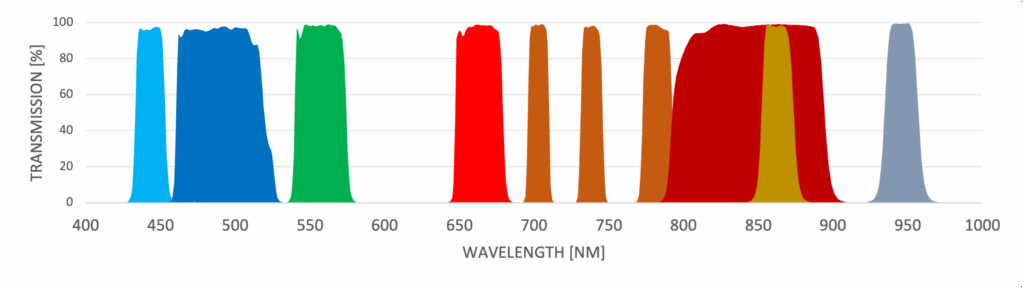
The careful selection of spectral bands is the key that opens the door to multiple Earth Observation applications. For example, at Simera Sense, we enable our MultiScape products to capture the visible and near-IR range in up to eleven bands. These bands are selected to complement the major EO missions and are available in 30 m, 5 m, and 1.5 m GSD from 500 km.
Coastal Blue [442 nm]
It is absorbed by chlorophyll in healthy plants and aids in vegetative analysis.
Least absorbed by water and is very useful in bathymetric studies.
Substantially influenced by atmospheric scattering and has the potential to improve atmospheric correction techniques.
It is readily absorbed by chlorophyll in plants.
Provides good penetration of water.
Less affected by atmospheric scattering and absorption.
Sensitive to vegetation senescing, carotenoid, browning, and soil background.
It can be used for atmospheric corrections.
Able to focus more precisely on the peak reflectance of healthy vegetation.
Ideal for calculating plant vigor.
More accurate vegetation and crop classification.
Detect algal and cyanobacterial blooms in water.
Identification of urban recreational areas.
This band is frequently used to identify soil types and geological features.
Better focused on the absorption of red light by chlorophyll in healthy plant materials.
Used for the discrimination between artificial objects and vegetation.
A helpful parameter in vegetation indexes.
Red Edge [705, 740, 783 nm]
Broad NIR [842 nm]
Narrow NIR [865 nm]
Absorption [945 nm]
The bands are strategically placed to sample the transition to the high reflectivity portion of the vegetation response.
Very valuable in measuring plant health and aiding in the classification of vegetation.
Assist with the consolidation of atmospheric corrections and the fluorescence baseline.
Very effective for the estimation of moisture content and plant biomass.
Effectively separate water bodies from vegetation types and discriminates between soil types.
The reflectance band within an atmospheric window region.
It is used within the atmospheric pre-corrected differential absorption algorithm.
The band is compared to Landsat-8 OLI NIR band-5.
The measurement band within the absorption region.
Useful for atmospheric corrections.
Spectral band selection is crucial for deeper analysis and faster insight into the Earth’s surface and atmosphere. Contact us to learn how our spectral band options can enhance your next optical EO mission.