- Earth Observation cameras /
- xScape200 Dual-Use /
- TriScape200 Dual-Use
TriScape200 Dual-Use
Capture high-resolution RGB imagery from a compact, low-SWaP payload designed to maximise mission performance while reducing spacecraft size, launch cost and programme complexity.
Key features
The TriScape200 DU empowers you with more Earth Observation capability at a lower SWaP.
1.5 m
12.3 km
12U
Volume
450–680
8.50W
8192 x 5460
Key benefits of the TriScape200 Dual-Use
Lower mission cost
High resolution from compact satellites
Scale your constellation
Faster time to orbit
Flight proven
Designed for global missions
Easier procurement and lower total mission cost
The ITAR-free configuration reduces dependence on US-controlled technology, supporting broader international procurement options. Benefits include:
Greater choice of launch providers
More integration partners
Better support for sovereign Earth Observation programmes
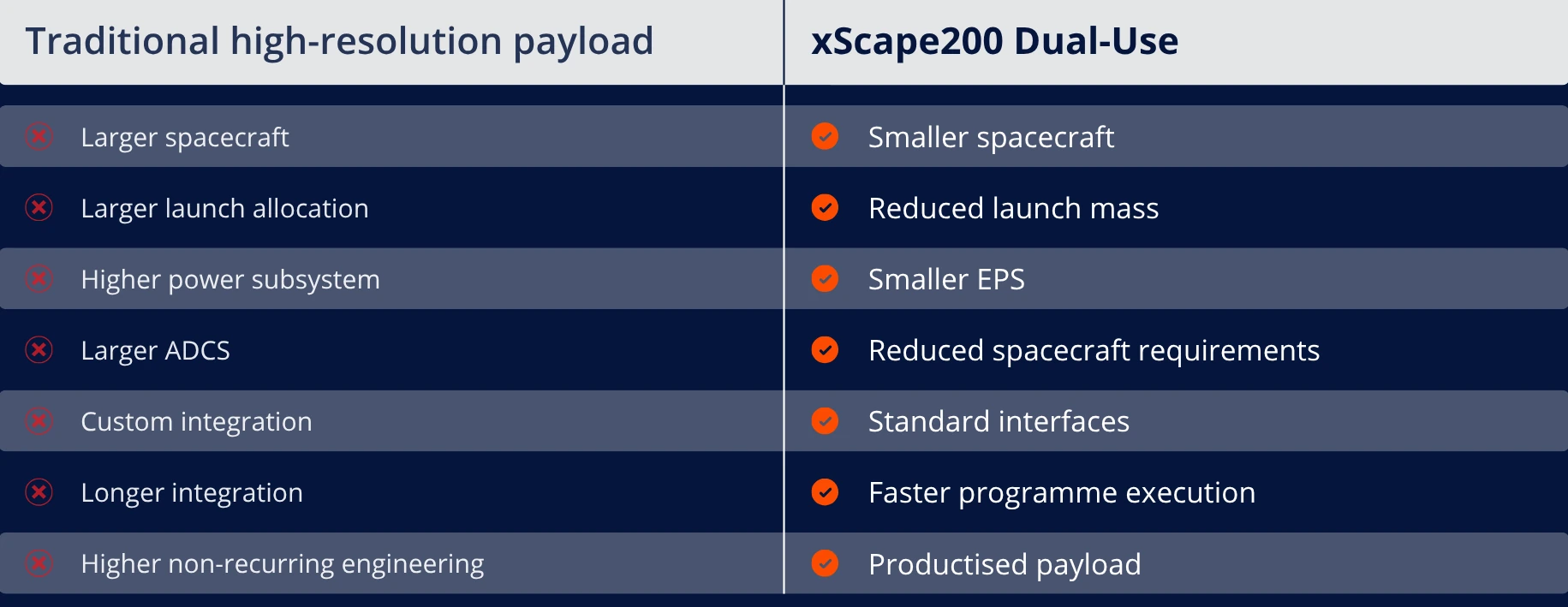
Traditional VHR payload
-
Larger spacecraft
-
Larger launch allocation
-
Higher power subsystem
-
Larger ADCS
-
Custom integration
-
Longer integration
-
Higher non-recurring engineering
TriScape200 Dual-Use
-
Smaller spacecraft
-
Reduced launch mass
-
Smaller EPS
-
Reduced spacecraft requirements
-
Standard interfaces
-
Faster programme execution
-
Productised payload
Technical specifications
Detailed technical specifications for the TriScape200 Dual-Use imaging system.
Focal length
1067 mm
Aperture
190 mm
Effective full field of view
Configuration
Snapshot
Sensor
Resolution
Pixel size
Pixel depth
12 bit
Spectral filter
Storage capacity
Control interface options
- I²C
- SPI
- RS-422
- SpaceWire
Data interface options
- LVDS
- SpaceWire
Power supply
Power consumption at 25°C
- 2.50 W (Idle Mode)
- 8.50 W (Imaging Mode)
Volume
Mass
Operating temperature
-10°C to +50°C
Radiation (tested total dose)
Documentation
xScape200 Dual-Use ICD (Draft)
xScape200 Dual-Use Imager Envelope
xScape200 Dual-Use User Manual
xScape SpaceWire ICD
xScape200 DU documentation